Being human in the distance between who you are and who you will become. Imagine that all the habits, fears and choices carrying you today are signals squeezed into a jar. The jar grows, the signals multiply; but the question is: is it really you who is growing, or only the noise? The great delusion of the modern age is that we confuse an expanding stream of data with an expanding self. And yet sometimes a person can stand like a stranger in the middle of their own life.
Try a thought experiment. Picture everything that makes you who you are today, every decision, every habit, every silence, as a signal inside a jar. The jar grows. But are you growing? Or are you only collecting more signals?
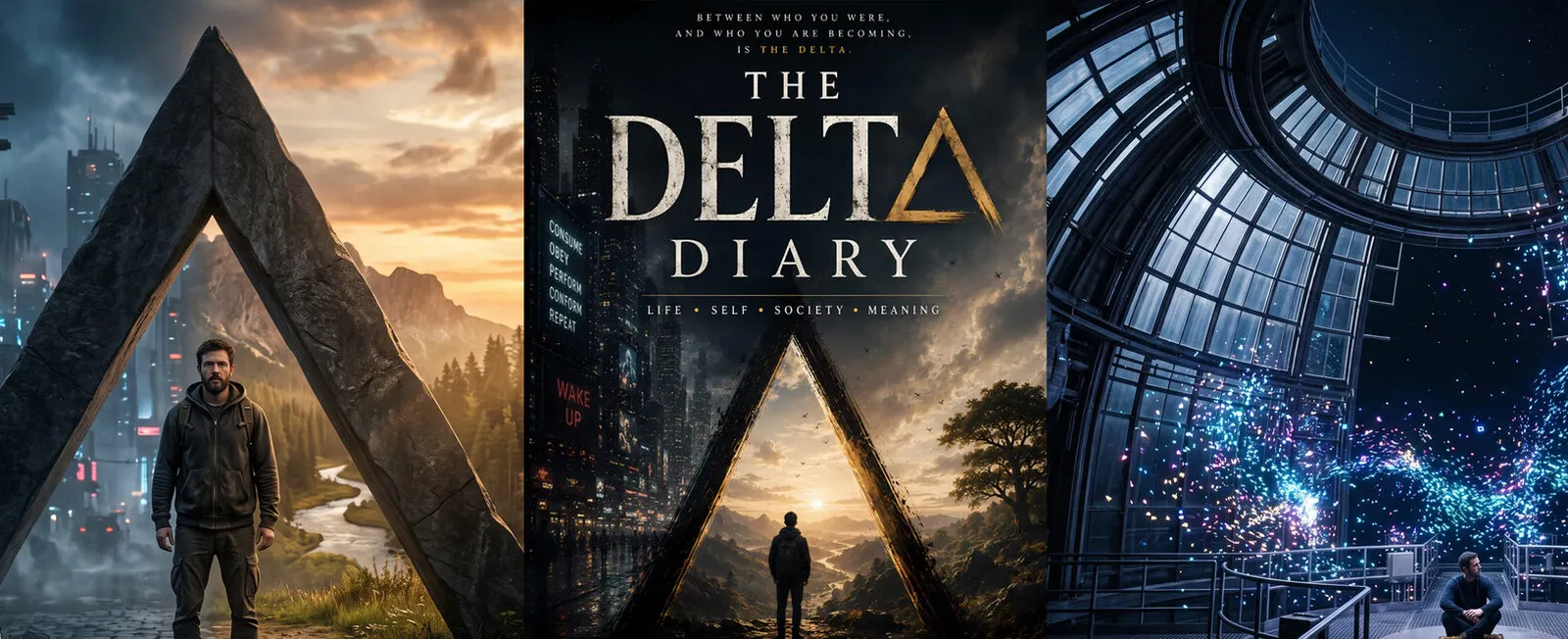
In his book The Delta Diary, Jason Daniel asks exactly this question. And instead of answering it, he leaves the reader inside it. On the left of the book's cover, words are written on the wall of a dark city: Consume. Obey. Perform. Conform. Repeat. On the other side there is a sunset, a forest, a river. And in the middle, a single man passing through a triangular doorway. He looks neither at the city nor at nature. He simply stands in the very middle of that threshold. That is the real conflict of this century: freezing at a point of transition.
Daniel's book is not a self-help book. There is no list of exercises, no advice on morning routines. What he does is harder and more uncomfortable: he shows how modern life wears people down, and why this is not an individual failure but a matter of systemic design.
The numbers already speak: seventy-three percent of Generation Z experience digital burnout. People look at screens for an average of seven hours and two minutes a day. Sleep disorders, chronic anxiety and attention deficit are no longer exceptions but the rule. And the most dangerous part is that we call this normal. Daniel puts it this way: the human nervous system was not designed to process this many stimuli. We are a species evolutionarily programmed to wake with the morning dew, to think by the fire in the evening, to read danger by looking at the sky and the soil. What are we given now? Forty notifications a minute. Outrage selected by algorithms.
Imagine 2075. Artificial intelligence is no longer just a tool; it makes most decisions, produces content, analyses health data, forecasts the economy. Brain-computer interfaces have reached mass consumption for the first time. Waves of migration triggered by climate change have turned the demographics of cities upside down. And somewhere, perhaps in Istanbul, perhaps elsewhere in the world, there is a child who, on waking each morning, faces both an algorithm's suggestion and their own instinct.
What that child will hold is the question at the heart of The Delta Diary: am I choosing who I am, or is it someone the system has chosen for me? Every great human leap of the past, fire, agriculture, writing, the printing press, industry, both strengthened us and took something from us. What will AI give, and what will it take? My guess is this: AI will offer to spare us the effort of deciding. And most people will gladly accept, because they are already tired of those decisions. But this is exactly where Daniel's “delta” appears. If you are not making your decisions, then you are not living your transformation either.
I need to correct a misunderstanding here. When we say “staying human,” we are not talking about opposing technology. This is not about conservatism or the trap of nostalgia; it is about conscious being. In The Delta Diary, Daniel draws attention to the difference between performance and presence. Modern people are constantly performing: one version on social media, one at work, one at the family table. Each slightly different from the others, none entirely real. This fragmentation of identity deepens under pressure; stress, loneliness and meaninglessness widen the cracks.
The deepest layer of The Delta Diary is philosophical. Daniel questions humanity's place in the universe. AI is teaching us that intelligence is not only a biological process. Does this knowledge make us smaller, or larger? I believe it makes us larger. Because if we can design intelligence, then intelligence is not merely a trait that emerged from an evolutionary accident; it is a tool through which the universe tries to understand itself.
It took billions of years to create you. A supernova exploded, atoms joined, the ocean foamed, DNA coiled its spiral, a synapse fired for the first time. And here you are, in front of a screen, reading these sentences. This is no coincidence. It is an image of existence trying to realise itself. That is why “staying human” is not resistance but responsibility.
This column is called The Man in the Jar, and there is a reason for that. The system keeps us inside invisible glass. The jar is comfortable. The jar feeds us. The jar protects us from danger. But inside a jar you cannot become something great.
The man passing through the triangle on the cover of Jason Daniel's book looks neither at the city nor at nature. He stands within that threshold. And perhaps that is the bravest place of all: not fully safe, not fully free, but moving. Over the next half-century this journey will become far faster, louder and more complex. Only one thing will stay firmly in place: the delta, that moment of transition in which you stand on the threshold, still belongs to you alone. Algorithms may plot your route, systems may steer you, technology may optimise your existence. But only you decide whether you pass through the triangular door of that transformation, and what you carry to the other side. And that is why I am still hopeful.
Reference: Jason Daniel, “The Delta Diary: Life · Self · Society · Meaning” (2024)