Woman, who mends the torn fabric of time with ancient tenderness, is the one cosmic architect who once wove the soil with Cybele's abundance and today weaves the future with digital pixels. Even as matter evolves into data and the museum into the metaverse, the aesthetic genetics of life will find meaning only through woman's ordering, transformative spirit.
Dear readers of Ekonomi Dünya, woman's energy of existence is the first spark of humanity's continuity. Standing at the centre of societies and of individual lives, as mother, partner, sister, friend, teacher, resister and guardian of peace, woman does not merely sustain life; she gives it form. For us to imagine a peaceful and happy future, women's creativity and grace must remain at the centre of life, both metaphorically and concretely. Because it is she who, through her biological, cultural and aesthetic creativity, ensures the continuity of the world.
In my view, this existential centrality was not shaken by the adventure that began with the steam of the industrial revolution and continues at the speed of light in the digital revolution. In every age women have led and inspired; sometimes as a quiet force, sometimes as a visible revolutionary, they have instilled a “conscience” into new technologies. As the tailor of time, woman has cut and shaped the fabric of the ages and sewn aesthetic stitches into its tears.
The objects Orhan Pamuk collects in The Museum of Innocence, from a hairpin to a cigarette butt, are in fact knots of memory. Woven from Kemal's passion for Füsun, this museum is a concrete archive of collective consciousness. Today, however, the physical weight of memory is moving into the cloud and into NFT corridors. The migration of cultural heritage into the metaverse is not only a technological leap; it also makes women's experience timeless. Fine details doomed to vanish in the physical world become indelible traces in the digital universe. Women's narratives, silenced throughout history or hidden between the lines, are rising on the blockchain like unshakeable monuments of truth.
Along the line from the industrial revolution to the digital age, humanity has re-encoded its memory with every invention. Today, NFT archives and blockchain-based memory stores turn individual experience into unalterable records. Women artists and storytellers can encode their stories with ownership and the right of representation. Memory thus moves beyond patriarchal one-sidedness into a space of many voices. This is where the question of giving AI an “ethical compass” arises: algorithms process data, but which data is chosen and which human framework is drawn depends on will. Women's practices of empathy, care and generative thinking are the strongest guide for steering this technological power in humanity's favour.
Along the line from Hypatia to Marie Curie, from Halide Edib to Afife Jale, from Frida Kahlo to Ada Lovelace, a common vein runs: each of them crossed the boundaries of her age and carried new nourishment to the roots of the tree of life. Their courage, intuition and creative energy remain the most reliable foundation for understanding the digital revolution. The algorithmic thinking these pioneering minds set in motion is the founding spark of today's AI; and that spark proves that woman's intellectual and cultural fertility is as indispensable as her biological fertility.
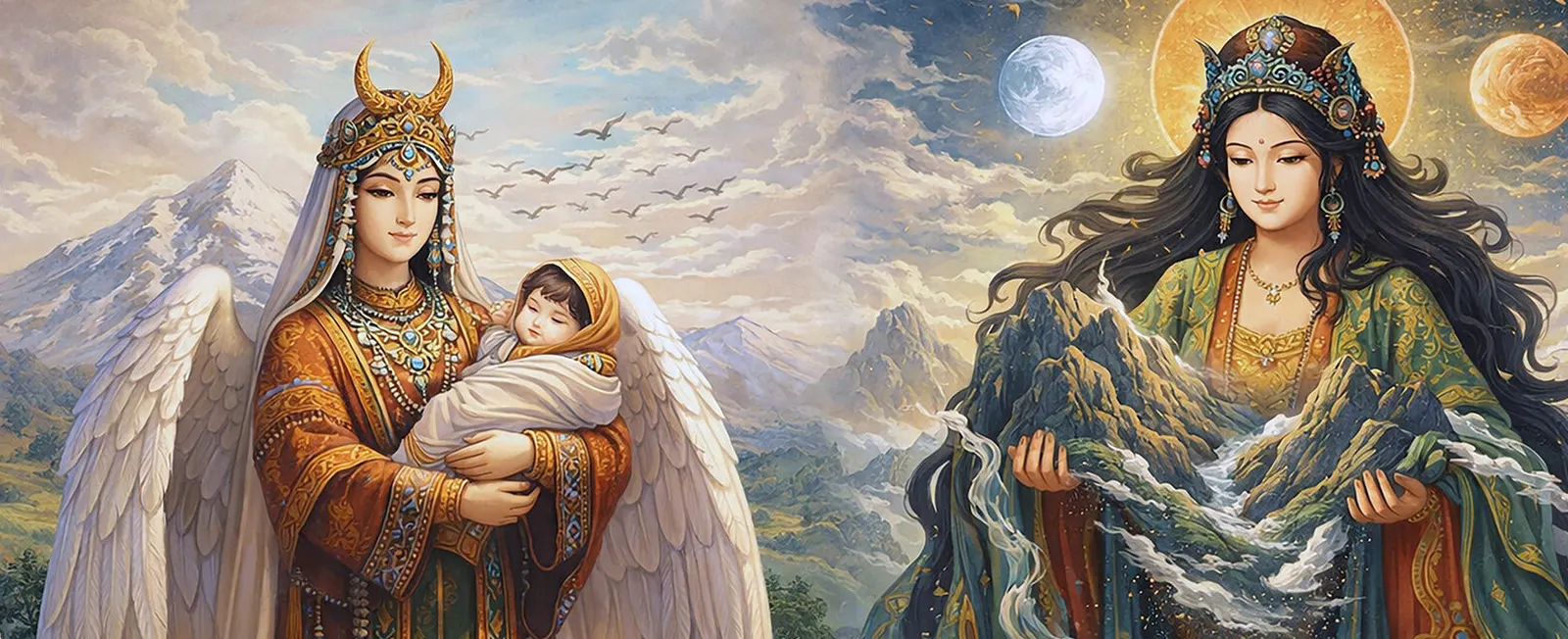
Born in the mountains of Anatolia, Cybele (Kybele), the mountain mother goddess of Phrygia, is the mother of wild nature and abundance. In Turkic-Altaic mythology, Umay Ana is the invisible protector descending from the heavens, a celestial sanctity symbolising the material and spiritual bond of birth. Mesopotamia's Inanna is a dynamic, transformative feminine power, while Egypt's Isis is the sorceress mother who gathers the scattered body and stitches life back together. South America's Pachamama is a universal source of energy uniting time and space.
These mother goddesses represent a matriarchal power beyond patriarchal orders. Woman is a being who nourishes in silence but rises as a storm when needed. Their legacy still lives on today in women's practices of empathy and care. As we search for an ethical compass for digital evolution, these archetypes remind us that grounding technology on a human plane is also possible only through this wisdom of cosmic motherhood.
The metaverse is not merely a three-dimensional simulation; it is a narrative space in which cultural heritage is staged anew. The chain of memory stretching from Anatolia's lullabies to its epics has been carried for centuries by women's voices. In the metaverse this chain can become interactive experience: a digital room can connect a mother's voice to the present; an NFT collection can add a personal archive to collective memory. This transformation is as ontological as it is economic: the narrative economy produces not only content but identity and belonging. As both the founder of the story and the guarantor of its transmission, woman is once again at the centre.
In this new age, in which memory evolves from matter to data, from the shop window to the pixel, forms may change, but at its heart always stands human experience, and especially women's narrative. Woman, the tailor of time, works aesthetics like a genetic code as she cuts and sews the ages. As humanity searches for the soul of the technology it has created in the age of AI, the most reliable guide is still women's practice of making meaning. The cosmic spirit reveals itself in a new form in every age. Now this spirit is building a new architecture of memory in the digital universe. And at the foundation of that architecture, once again, lies woman's transformative energy.
Until we meet in the next issue, stay in light and love.