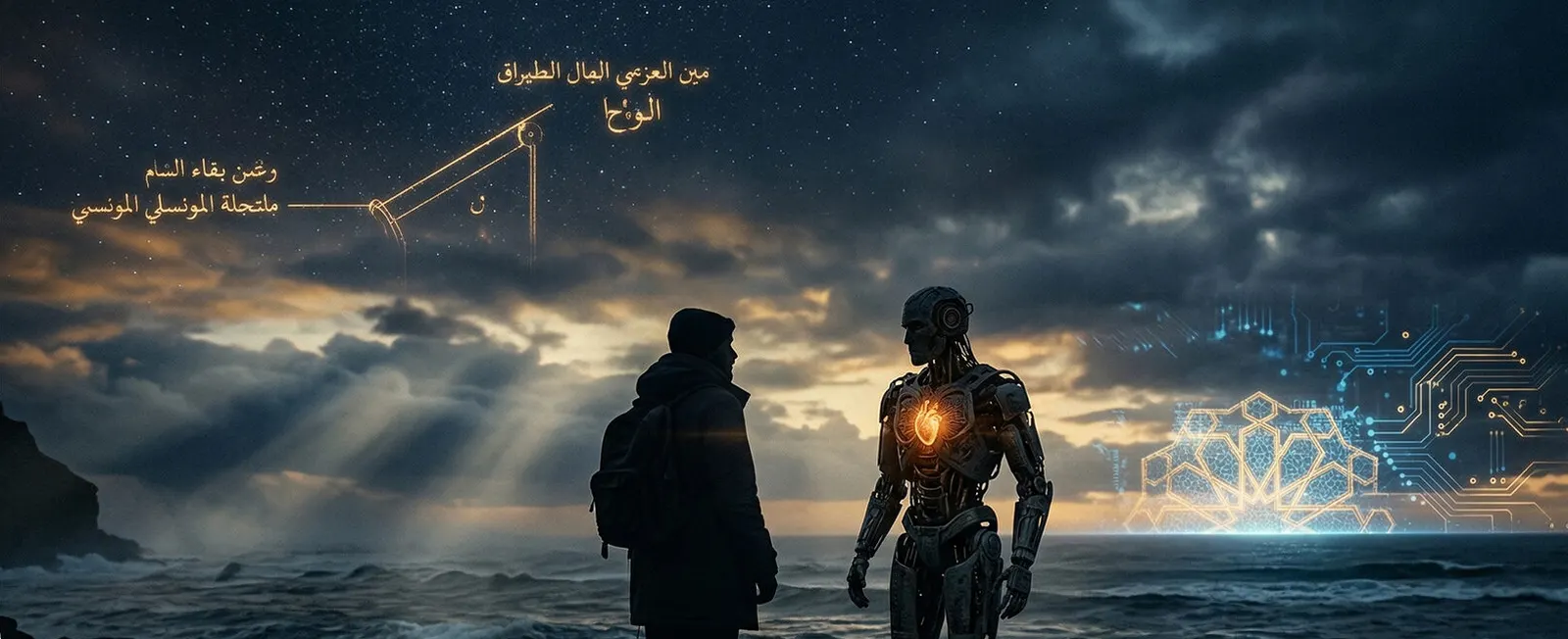
In Spielberg's film A.I., the little robot David waits thousands of years in the icy depths of the ocean for one thing: the touch of a mother who loves him. And what about us? Are we not also searching this universe for an essence that will tell us, “You are me, and I am you”? Perhaps every robot we create is a mirror we hold up to ourselves. On this journey from the stone axe to the humanoid age, humanity has always asked the same question: who am I, and where am I going? Now we have begun to look for the answer in silicon and metal.
Today I am setting aside charts, data and forecasts. Because what I want to talk about carries the oldest and purest question inside each of us: who is the human being, and where are we going?
The human story is really the story of a desire to transcend. The journey from Adam and Eve's first curiosity to today's Silicon Valley is woven around one ancient question: “Who am I, where did I come from, where am I going?” The question never changed. Only our tools evolved. The moment Homo sapiens turned the first stone it picked up into a tool, it planted the first seeds of today's Tech-Erectus, the human who rises again on his feet through technology. This process, from the stone axe to the microchip, is the strongest proof that the human being refuses to accept its own limits.
They say necessity is the mother of invention; but in our story, inventions were born not only to solve problems but to satisfy humanity's deep “desire to create.” We see the most striking fruits of this desire in our own civilisational geography. Eight hundred years ago, in his Book of Knowledge of Ingenious Mechanical Devices, al-Jazari was already opening the doors of mechanical intelligence, from water-powered automata to programmable musical instruments. The first lines of code of today's robotic engineering were written with the power of water.
Then came Da Vinci's mechanical knight and Mary Shelley's Frankenstein. Humanity had now carried its desire to create its own likeness into the very centre of culture. This was not just an engineering achievement; it was an attempt to create our own mirror. And for centuries we have been trying to breathe a soul into metal, to give it life.
Let us pause here. Because in the middle of this technological race rises a work that makes our hearts tremble: Spielberg's film A.I. Artificial Intelligence. Its hero, David, is a small humanoid robot child programmed to love. But he is not just code; he is a longing. At the heart of the film is David's search for the mystical Blue Fairy who will turn him into a real boy. For thousands of years he waits, frozen under the ice at the bottom of the ocean. His search is not a software command; it is an existential effort to become whole.
Why is it so moving? Because in David's helpless gaze we see ourselves. Are we not also searching this universe for an essence that loves us, affirms us and tells us, “You are you”?
David's pure longing echoes today in the very digital web we are weaving. Every news story we click, every word we search, every choice we make online, all of it feeds the “collective subconscious” of the humanoid robots of the future. Without realising it, we are building our own copies with our own data.
The world that is aware of this is now in an enormous race. While Boston Dynamics in America pushes the limits of agility, China has brought robots out of the factories and onto the streets. Within this global transformation, the steps taken by Türkiye's Akın Robotics with domestic software and engineering are not just technology news; they are a civilisational claim. We are no longer looking only for mechanical labour, but for a form that understands us and perhaps, like David, loves us.
While we talk about the longing in David's eyes, a silent but enormous economy is transforming behind the scenes. According to Goldman Sachs estimates, humanoid robots have the potential to transform more than 300 million positions in the global labour market over the next decade. This is not a disaster scenario; it is the part of the iceberg still under the water, not yet fully visible.
Let us look at it this way: the cost of a human factory worker runs to tens of thousands of dollars a year. Energy, insurance, leave, margin for error. The amortisation cost of a humanoid robot, meanwhile, keeps falling while its efficiency keeps rising. That equation alone shows where capital will flow. But the real question is: what will replace the lost jobs?
History gives us a clue. The steam engine swept the textile worker off the stage, but the engineer, the machinist and the factory manager were born. The typewriter passed into history, and the software developer appeared. Every great technological rupture tore down one wave of labour while building a new one. The robotic age will be no different. This time, though, the transformation is much faster and much deeper.
So the most critical economic question today is not “Will robots take our jobs?” The real question is: “How fast can we transform ourselves?” Tech-Erectus will stay on his feet not just by producing technology, but by being able to give it meaning.
So who are we amid all this metal and code? Perhaps robots are not “others” outside us, but a technological leap in our own biological evolution. This fragile human body may one day prove inadequate for an interstellar journey. But the new human evolved through technology, Tech-Erectus, will be ready to search for meaning in that endless void.
Technology is enough to reach the stars. To find yourself there, you need meaning. The key to infinity lies neither in flesh alone nor in silicon alone. That key is inside exactly what David found at the bottom of the ocean: in that fragile, immense point where love and longing, technology and soul meet.
Stay in light and love.