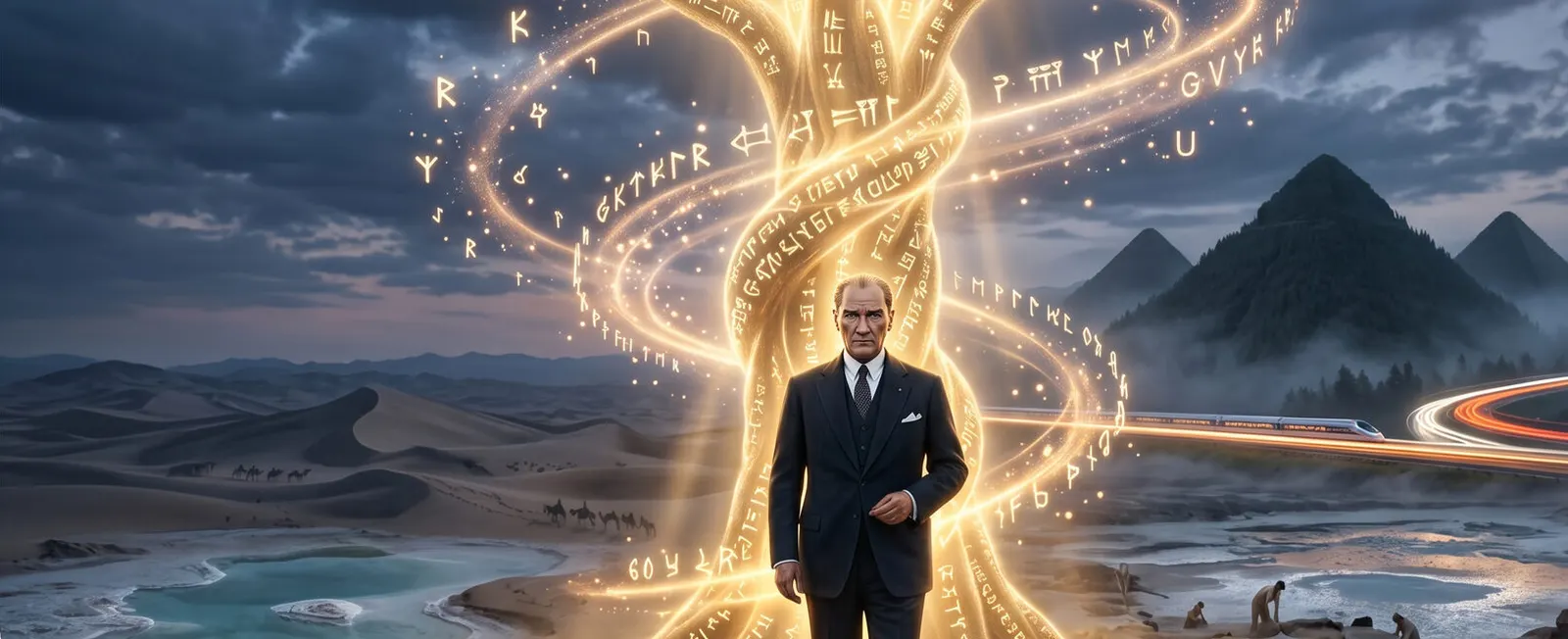
This is a perspective that looks for humanity's lost beginnings not in oceanic fairy tales but in the buried cities of the Gobi, the talking mummies of the Tarim and the silent pyramids of Xi'an. This line makes visible again not only the first spark of civilisation but the real roots, in deep time, of Turkish culture, the Turkish language and Atatürk's vision of history.
I am chasing one of the greatest and oldest questions in human history: where, how and by whom was civilisation first set in motion? For years the human mind has taken refuge in the romance of mythical continents such as Mu and Atlantis, buried in the darkness of the oceans. In my view, however, the real missing links of history lie not in tales from the ocean floor but in the heart of Eurasia: in the burning sands of the Gobi Desert, in the salty soil of the Tarim Basin and in the tangible reality of the vast, mysterious pyramids rising over the plains of Xi'an in north-western China.
My aim in this article is not only to tell a story of history. It is to show, with archaeological and geological evidence, the link between that immense line from the Gobi to Xi'an and early Turkic cultures; to understand the depth of Atatürk's vision; and to reread today's global balance of power through this deep memory.
The legends of Mu and Atlantis, so common in popular culture today, are in fact occultist narratives constructed to support the colonial mindset of the nineteenth- and twentieth-century West. The “Naacal Tablets” put forward by figures such as James Churchward, never physically verified, and the idea of a “superior class of white priests” based on them were essentially nothing more than an attempt to universalise the theory of an Aryan race.
Modern geological data and ocean-floor surveys, however, flatly reject the existence of vast sunken continents in the Pacific or the Atlantic. Searching for the origins of civilisation on these imaginary continents is therefore nothing more than the West's attempt to find roots for its own claim to superiority. Real civilisation was taking shape in a far more real and far harsher geography: on the steppes and in the river valleys of Eurasia.
This is exactly where we must turn to the genius and vision of Gazi Mustafa Kemal Atatürk. From a shallow perspective, it is often claimed that Atatürk based his Sun Language Theory on the legends of Mu. This is a great misconception. Atatürk read Churchward's books line by line and wrote notes in their margins in his own hand, but he always approached those speculative claims critically and from a distance.
Atatürk's real concern was not to create a myth but to demolish the racist approach of West-centred historical theses that declared the Turks “barbaric and without history.” By personally funding the then-emerging fields of Sumerology, Hittitology, anthropology and linguistics, he wanted to prove scientifically the deep-rooted place of the Turkish language and culture in the tree of world civilisation. The Sun Language Theory was not a rootless claim but an immense construction of national memory, tracing the footprints of Turkish intellect and language through deep time. The founding of anthropology institutes after the proclamation of the Republic and the opening of the Turkish Historical Society and the Turkish Language Association were strategic steps in this far-reaching work of memory.
Where, then, is the concrete, tangible evidence of this deep memory? Our first stop is the Gobi Desert. According to geological surveys, this land, which today looks like an endless drought, had vast lake beds, river systems and an extremely fertile ecosystem thousands of years ago. Turned into desert by climatic ruptures and the sudden drying after the Ice Age, the region holds an enormous potential for a “buried civilisation” beneath its surface.
Just to the west of this line, archaeological discoveries in the Tarim Basin overturned established assumptions. The Tarim Basin mummies, dated to around 2000 to 1800 BCE and known by names such as the Beauty of Loulan (Krorän) and the Cherchen Man, are the most striking evidence of history's lost transitional cultures. Preserved thanks to the salty, arid soil down to their hair, their eyelashes and even the stitching on their clothes, these mummies challenge mainstream historical theses. The advanced twill weaving seen in their garments clearly reveals mixed cultural elements where European and Central Asian lines intersect, as well as Proto-Turkic physical features.
When we follow the flow of civilisation south from the Gobi and the Tarim towards the plains of Xi'an, the ancient capital of China, we come face to face with one of humanity's best-kept secrets: the Chinese pyramids. For years these huge earthen structures were camouflaged as ordinary hills by the Chinese government, planted with trees and surrounded by military zones; in fact they are monumental pyramid tombs stretching along the Wei River valley.
So why did China feel the need to hide these pyramids from the world? Because these structures point to a time long before the Han dynasty and the institutional birth of Chinese civilisation, to the architectural, religious and burial traditions of the Turkic, Scythian and Yuezhi cultures that ruled the region. These pyramids, the kurgan burial tradition of the steppe peoples grown to monumental scale, prove that Chinese civilisation did not arise as a homogeneous whole. On the contrary, Chinese civilisation was built on the logistical, military-organisational, equestrian and architectural heritage of the ancient Turkic-Scythian culture of the steppe.
This historical continuity connects us to today's modern world, to geopolitics and to the global economy. China's current global economic rise, its vast productive power and its Belt and Road project are not chance strategies drawn up at a desk; they are an explosion of geographic memory. China knows what it means to be at the centre of the ancient Silk Road, with the genetics of trade, logistics and supply chains accumulated along that route over centuries. The trade routes whose logistical security was historically ensured by Turkic-Scythian peoples have today become the global arteries of the modern Chinese economy.
On the other side of the coin, however, stands Türkiye. Across the broad Eurasian geography from the Gobi-Tarim line to Anatolia, Turkic culture has been not only a military power but the main artery connecting civilisations and continents. The wide geographic spread of the Turkic languages, their flexibility and the mathematical structure they have preserved over thousands of years are the greatest legacy of this deep-rooted past. Türkiye's present geo-economic position, its place at the centre of energy corridors, is the keystone of this deep historical flow in the modern world. We draw our logistical and geographic intelligence from these roots.
Mu and Atlantis may remain pleasant fantasy stories for us, but the Gobi-Tarim-Xi'an line is the real, tangible history of humanity, history that springs from the soil. When Atatürk defined the borders, language and identity of the Republic he founded, he drew his strength not only from military victories on the front but from this awareness of deep time and historical legitimacy. Today, as we build Türkiye's economic, cultural and strategic future, we must turn our faces not only to the homogenising narratives imposed by the West but also to these deep, unshakeable roots of Eurasia.
The real missing link is not an island lost in the past; it is our sense of belonging to our own roots, and our ability to integrate this immense heritage into the economy, science and intelligence of the modern world. The compass is in our hands, and our roots are waiting for us in the heart of deep time.
This article was written as a geo-economic synthesis of the archaeological data presented in J. P. Mallory's “The Tarim Mummies” and Christopher I. Beckwith's “Empires of the Silk Road,” together with Gazi Mustafa Kemal Atatürk's vision of language and history.