It is time to tear down the digital curtains lowered over our eyes. We live in a twilight zone where artificial intelligence does not merely imitate reality but takes its place, where pixels smother the truth. Amid the manipulative bombardment of data we are exposed to every second, amid fake faces and fabricated voices, our minds are fighting a defensive war.
So what will lead us out of this digital prison and the numbing effect of the simulation: just a pair of high-tech glasses, or that ancient, conscientious “filter” we have forgotten somewhere deep inside, the one that makes us human? In this age, seeing the truth is not a preference; it is a struggle for existence.
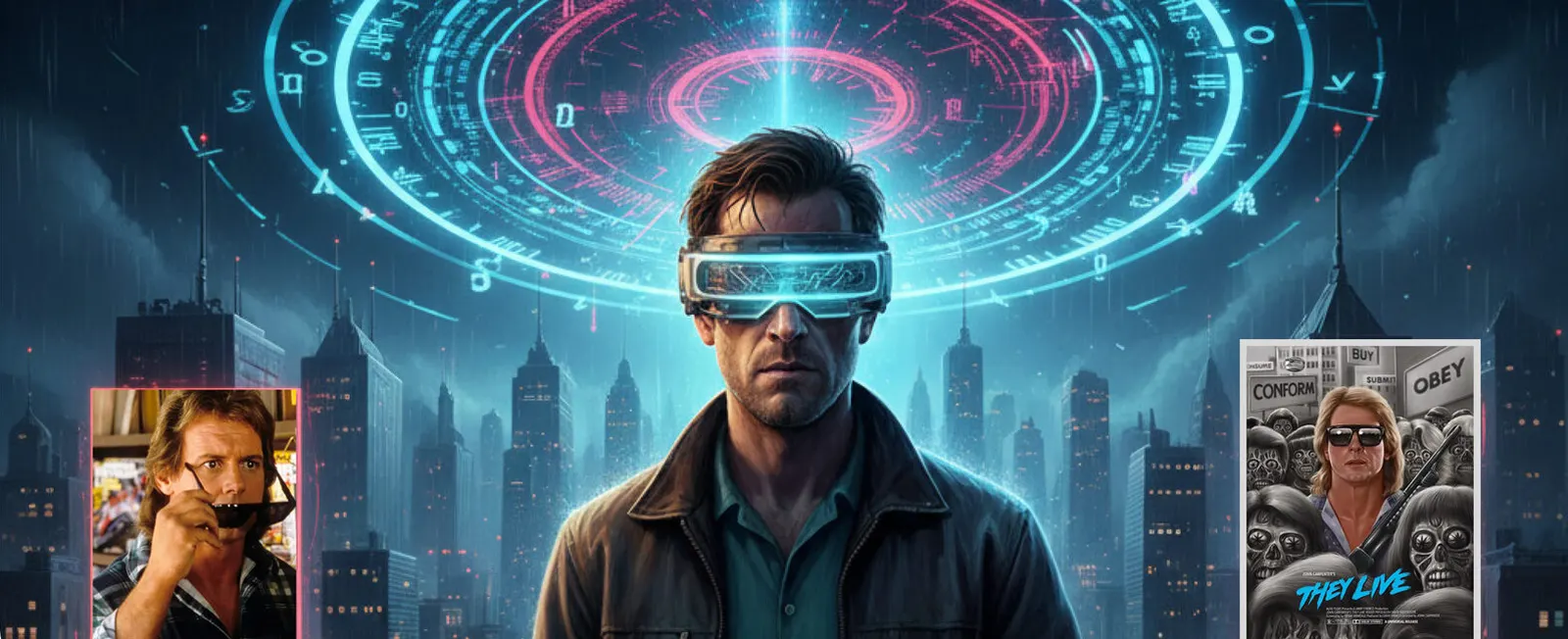
In 1988 John Carpenter made one of the harshest critiques of the system in film history: They Live. In it, an ordinary worker finds a pair of sunglasses and sees that the world has in fact been invaded by aliens, and that commands such as “Obey,” “Consume” and “Do not think” are hidden behind billboards. Seen at the time as a science-fiction action film, it became a cult classic over the years and a symbol of “perceptual awakening.” Carpenter's glasses were, in a sense, the first prototype of the Reality Filter we need today.
What was then only an ideological critique has now evolved into a digital necessity. Under deepfake videos, voices cloned with AI and a manipulative flood of data, we, like Carpenter's hero, no longer know what we are looking at and what we are really seeing. The legacy of They Live whispers this to us: reality is not always visible to the naked eye; sometimes you need an interface, a shield, to see it.
It has been a quarter of a century since the Wachowskis' The Matrix welcomed us into a prison of our own minds. When Neo chose the red pill, it was not just a choice but a passage from a comfortable lie to a painful truth. The Reality Filter glasses we are imagining would awaken something of Neo's spirit in the mind of modern man.
In the age of AI, each of us lives in a personal Matrix woven from datasets. Algorithms tell us what we want to hear and show us what we want to see. These glasses would act as a digital “red pill” to bring us out of that simulation.
So why do the giants of the tech world avoid making such a “defensive shield”? The answer lies in the elite of They Live and in today's imperial technological order. The current system is built on our capacity to be misled. Everything from our consumption habits to our political choices is shaped by manipulating our data. Big tech companies and global capital want the individual to remain “unfiltered” and “unprotected,” because a public that questions and instantly spots the fake is impossible to govern. For them, data is the new oil, and manipulation is the refinery that processes it.
Yet the essence of the matter is not hardware or software. In the end, it comes down to our own core values, morality and character. When the great Islamic thinker Al-Ghazali said, “The heart is a mirror; unless you wipe away its dust, you cannot see the truth,” he was describing a reality filter a thousand years in advance.
The striking teaching of Yunus Emre, “There is a me within me, deeper than me,” urges us to silence all the noise of the outside world and reach the higher conscience within. The reality filter is, in truth, a person's higher character. If someone is equipped with strong morals and conscience, they can tell a lie from the truth with that ancient filter of the soul, even without technological glasses. As Socrates said: “The unexamined life is not worth living.” These glasses would be a prosthesis that gives us back our ability to question; but the real power lies in the human will behind that interface.
Turning the idea of a Reality Filter into reality takes both individual and collective steps:
This piece is not just the introduction of an imaginary device; it is a call to free your mind and soul, your greatest defence mechanism. The Reality Filter is both a tool and a virtue: without a questioning mind, a compassionate heart and a brave community, no device can carry us to the truth. Put on the glasses, but above all, use your inner eye. The spark of awakening starts with a small crack in your point of view; making it grow is up to us.
May your heart and mind stay awake. Be well, “Om Mani Padme Hum.”