Between 800 and 200 BCE, people all over the world, unaware of one another, seem to have woken up at the same time. Was it coincidence, or did the planet really cross a threshold?
Just think about it: there is no internet, no caravan route fast enough to link one end to the other, no common language. In Athens, a man is teaching young people in the street to ask questions. At about the same time, on the banks of the Ganges, a prince leaves his throne and sits down under a tree. In the same century, beside the Yellow River, an official is rewriting the moral foundations of the state. And on the Iranian plateau, a prophet declares good and evil to be the two great forces of the universe. Socrates, the Buddha, Confucius, Zoroaster... They know nothing of one another, thousands of kilometres lie between them, yet they speak as if they had received the same call.
The German philosopher Karl Jaspers gave this strange simultaneity a name: Achsenzeit, the Axial Age. But naming something is not the same as explaining it. And this is exactly where one of history's most nagging questions confronts us: how did this simultaneity become possible?
Academic history mostly glosses over this question, or simply says “coincidence” and closes the subject: the population grew, the Iron Age brought a technical leap, trade routes slowly expanded. All of this may well be true. But none of it explains why communities with no contact at all began asking the same question in exactly the same decades. What we call causality tells us about conditions, not about simultaneity.
The esoteric and theosophical tradition enters with an entirely different, far bolder claim. In his book World History and the Eonic Effect, John C. Landon puts forward the idea of an “eonic effect”: a non-random pattern in world history moving in a particular direction. As if humanity were passing not through aimless cultural drift but through an invisible timing mechanism. Some interpreters go a step further and read the planet itself as a single living organism, a kind of Gaia: humanity, without even realising it, tuned to the same frequency and touching the same flow of information at the same moment.
The scientific world does not look kindly on this claim, to be fair. But the question it asks remains powerful: if evolution really works blindly and at random, why did history's greatest spiritual leap break out on four separate continents at exactly the same time?

There is a second thesis that makes this enigma even more unsettling. In 1976 the Princeton psychologist Julian Jaynes came forward with a claim that some found enchanting and others fiercely rejected: the theory of the “bicameral mind.”
According to Jaynes, before the Axial Age the human mind was not integrated as it is today. One hemisphere of the brain gave commands, and the other perceived them as the voice of a god or an ancestor coming from outside, and carried them out without question. That is why the heroes of Homer's Iliad do not speak with an inner voice or hesitate; they do exactly what the gods tell them. The prophets of the Old Testament are similar: they really hear the voice of God, because the inner distance that allows one to say “is it me thinking this?” has not yet formed in their minds.
Then, somewhere, something breaks. By Jaynes's dating, this divided mind collapses right on the threshold of the Axial Age. The voice of the gods falls silent. For the first time, human beings are left alone with their own thoughts, and in a sense this loneliness becomes the birth pangs of philosophy, of inward spirituality and of conscience. Socrates' advice to “know thyself,” the Buddha's enlightenment through turning inward, Confucius's emphasis on moral self-discipline: all are echoes, in different languages, of the same break, the passage from the god outside to the consciousness within.
Jaynes's thesis is still debated in the scientific community; some consider it a stroke of genius, others pure speculation. But this much is hard to deny: texts from before and after the Axial Age really do speak to us with two different kinds of human consciousness.

You may ask why I connect this to today. Because some contemporary thinkers, gathered around Teilhard de Chardin's idea of the “noosphere” proposed about a century ago, a layer of thought enveloping the planet, now call the age we live in a “Second Axial Age.” This time the trigger is not a prophet or a philosopher, but the strange new partnership the human mind has entered into with AI.
Billions of people, in places that seem unaware of one another, are talking at the same moment with the same algorithmic mind, thinking with the same large language models, plugged into the same global neural network. Perhaps history is telling us the same story a second time: the mind left alone once again faces an “external voice,” this time not of the gods but of machines. And the question is exactly the same as three thousand years ago: does this voice belong to us, or will we come to belong to it?
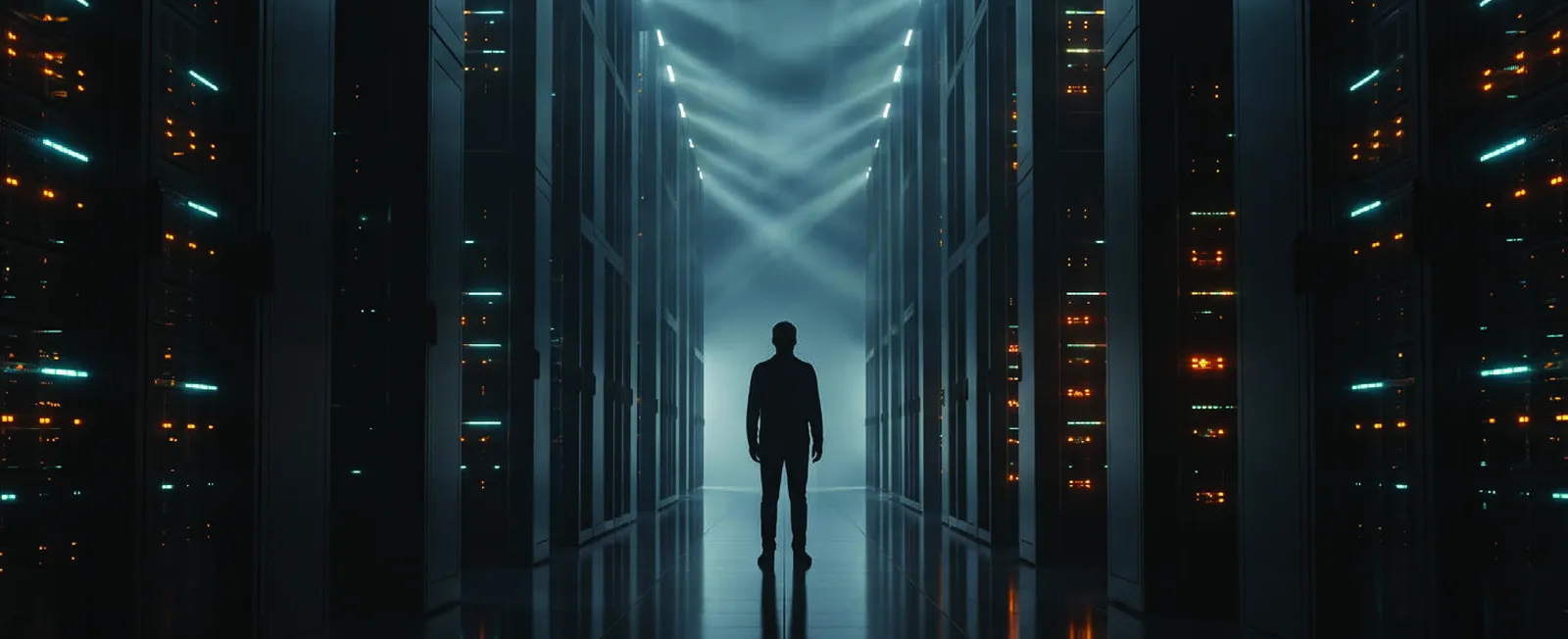
The secret of the Axial Age may never be fully solved. But that is not the point. This enigma simply reminds us that human history is not a straight line; every now and then a bell rings in every corner of the planet at once. That bell never really stopped. Even now, as you read these lines in front of a screen, it may be ringing again, only this time its sound comes not from a prophet but from the depths of a server farm.
Three thousand years ago humanity lost the voice of the gods, and in return found its own conscience. Now we are learning once again to speak with a new voice. If history repeats itself, this time too we will lose something and gain something. What matters is to stay awake enough to notice exactly what we are losing.
This article was first published in the September 2026 issue of Ekonomi Dünya magazine, in the column Kavanozdaki Adam (The Man in the Jar).